Documents are dead surfaces. This is what happens when you treat them as systems.
Most tools treat documents as files. Real work treats them as systems structured, contextual, and actionable.
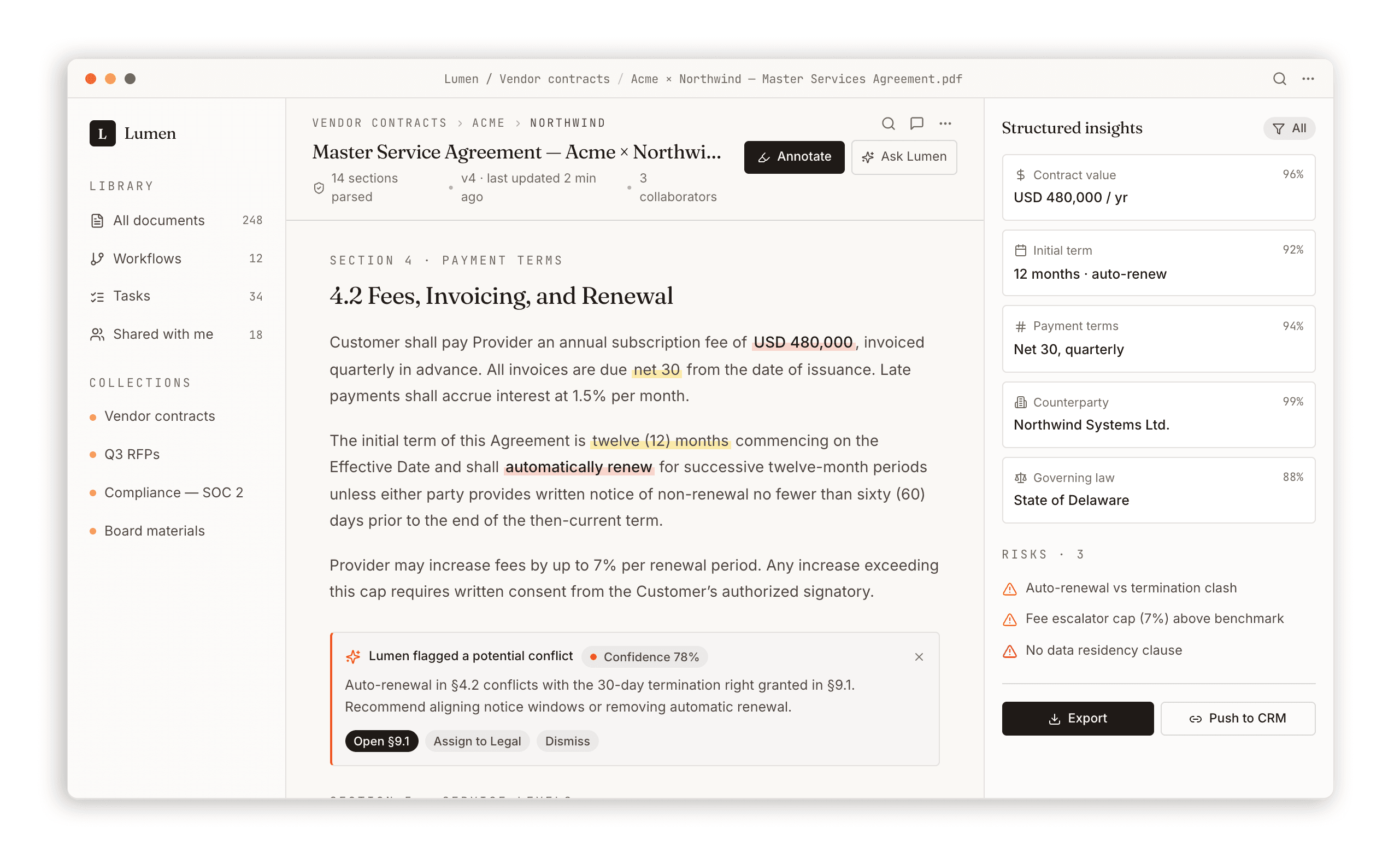
Lumen turns contracts, RFPs, research, and policy into addressable systems you can query, structure, and act on. This case study covers the system design, the tradeoffs I rejected, and the signature feature the product is built around.
ROLE
Lead Product Designer
Independent project
DURATION
3 – 4 weeks
Concept → system → coded vision
TEAM
Simulated cross-functional
Product, Engineering, AI/ML
OUTCOME
Shipped product vision
System design + signature feature
OVERVIEW
From files you read to systems you operate.
Lumen treats every document as a structured system parsed into sections, claims, obligations, and entities with an intelligence layer that makes it queryable and an action layer that makes it operational.
Most "AI for documents" products bolt a chatbot onto a PDF viewer. Wrong problem. The document itself never becomes more than ink on a page. Insights don't propagate. Obligations don't trigger work. Reviews don't compound.
Lumen's shift: Document → addressable system. Every clause has an ID. Every entity is typed. Every action assign, extract, escalate, export attaches to a specific span and survives the document's lifecycle.
PROBLEM
Generation is solved. The workflow isn't.
01
Documents are static representations of dynamic work.
The structure lives in the author's head, not in the file. Nothing downstream can address a clause, a party, or an obligation.
02
Insights are buried in unstructured content.
Skilled people copy-paste figures into spreadsheets. The most expensive work is also the most repeatable.
03
Actions are disconnected from context.
The renewal date in §4.2 doesn't create a calendar reminder. The risk in §11.3 doesn't open a ticket. Reading and doing are separate jobs.
04
Collaboration happens outside the document.
Comments in the doc, decisions in Slack, tasks in Linear, redlines in email. Nothing reconciles back to the source.
USERS & CONTEXT
Built for the people whose work the document is.
I scoped to three workflows, not three personas. Persona thinking would have produced features for an avatar; workflow thinking forced me to design the spine that connects parsing to action.
Knowledge workers
Workflow
Generate a hero, then spend two hours masking it into a usable layout. They want layers, not flattened JPEGs.
What changes
Stop re-reading to find what you already understood.
Analysts
Workflow
Extract structured fields across many similar docs → reconcile → report.
What changes
Skip the spreadsheet middle-step entirely.
Legal & operations
Workflow
Review → flag risk → assign → track obligations across the lifecycle.
What changes
The document becomes the source of truth for the work it generates.
SYSTEM DESIGN
The spine: a seven-layer pipeline with a feedback loop.
The system transforms documents from passive artifacts into structured, interactive systems.
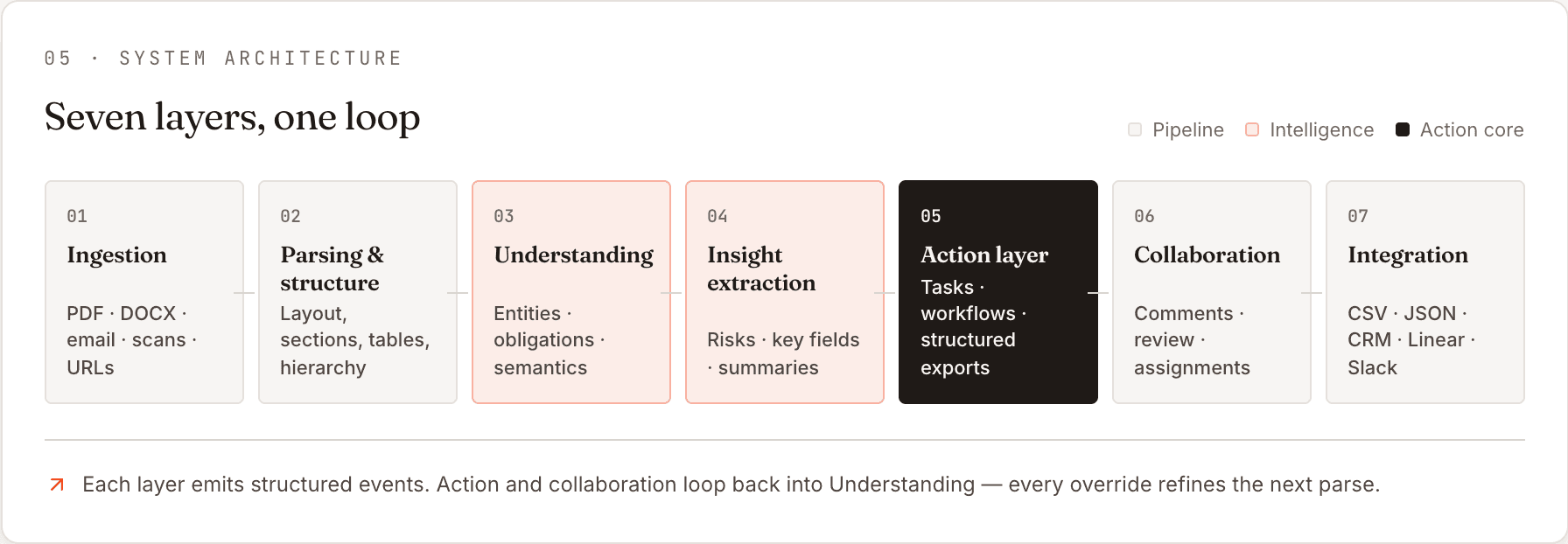
Ingestion normalizes anything readable into a canonical document object. Scans go through OCR with layout retention.
Parsing reconstructs hierarchy — sections, sub-clauses, tables — and assigns stable IDs so anything downstream can address a specific span.
Understanding is the AI layer. It tags entities, obligations, dates, monetary values, and semantic relationships between clauses.
Insights are derived views: risks, key fields, conflicts, summaries. They cite back into the document.
Action is where the product earns its name. Tasks, workflows, exports, integrations — all anchored to clauses.
Collaboration & integration close the loop: human edits and downstream system events feed back into Understanding.
KEY DECISIONS
What I rejected, and why.
TENSION
AI automation vs. human control
Suggested, never silent.
No field is auto-applied and no workflow runs unattended below 90% confidence. Full automation demos better and ships worse — it manufactures distrust the moment it's wrong once.
REJECTED
One-click 'auto-process' mode.
TRADEOFF
Slower onboarding for high-volume users; non-negotiable for trust.
TENSION
Raw document vs. structured data
Both, unified by one ID system.
Dashboard-only is lossy and alienating. Document-only has no leverage. Every structured insight links back to its source span — reading and querying are the same surface, not two products.
REJECTED
A separate 'data view' that diverges from the source.
TRADEOFF
Heavier engineering; the alternative breaks trust the first time the views disagree.
TENSION
Simplicity vs. depth
The canvas stays calm. Depth lives in the right panel and the copilot. Users must learn the panel exists; in exchange, the document never collapses into a dashboard.
REJECTED
Top-bar tabs that fragment attention across modes.
TRADEOFF
A learnable surface area; rejected the alternative because tabs train users to treat the doc as one feature among many.
TENSION
Passive reading vs. active workflows
Action lives next to content.
Tasks, exports, and workflows happen inline with the clause as context. Sending users to a separate action center would re-introduce the exact gap this product exists to close.
REJECTED
An external action center decoupled from the doc.
TRADEOFF
Denser canvas; the gap-free workflow is the entire thesis.
SOLUTION DESIGN
Four surfaces, one continuous canvas.
Each surface is opinionated on its own — but the real design work is in how they share state.
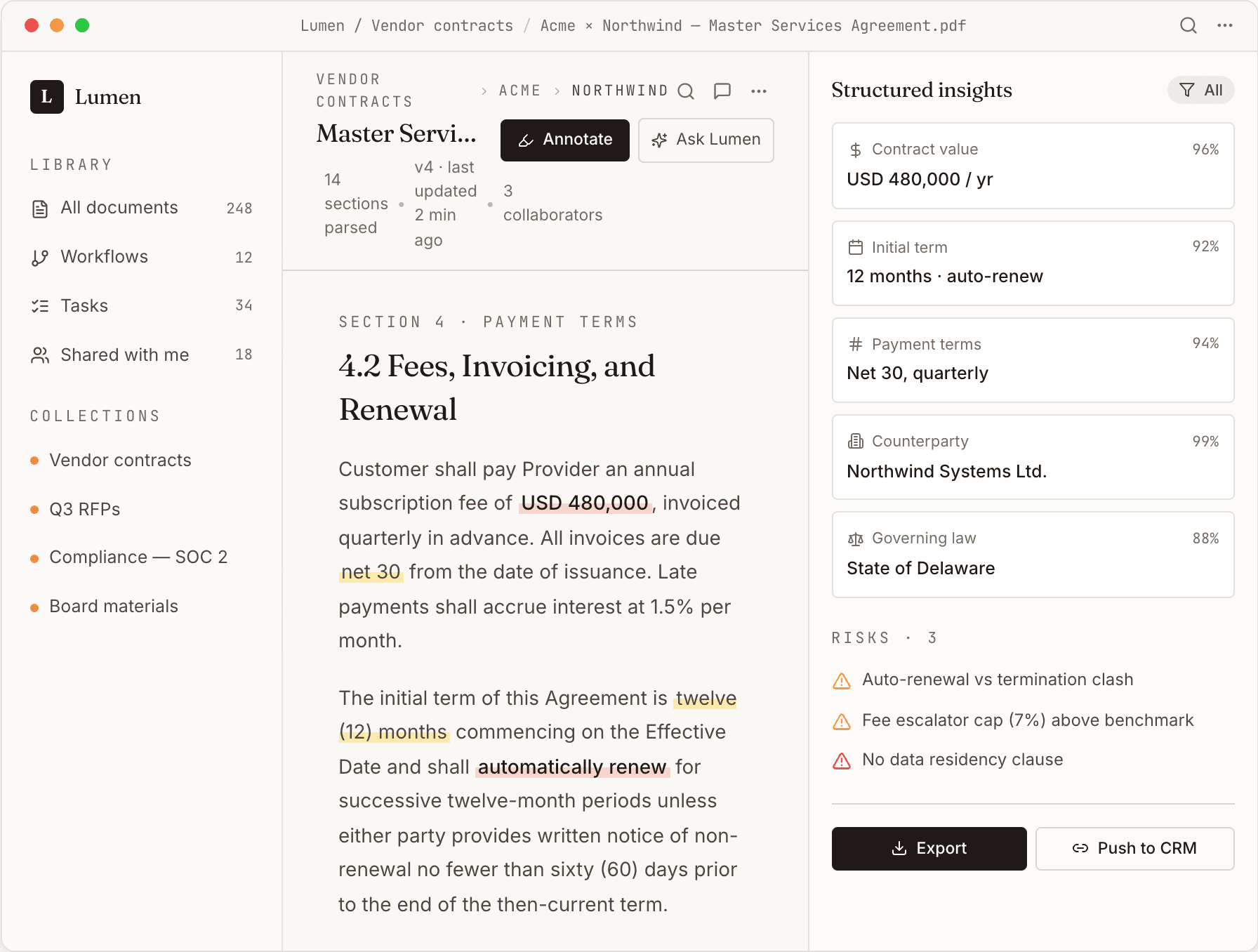
a · Intelligent document view
Reading surface, not viewer.
Typography for sustained reading; AI annotations live in the margin so the body text stays sovereign. Highlights are semantic — yellow for facts, accent for AI-flagged.
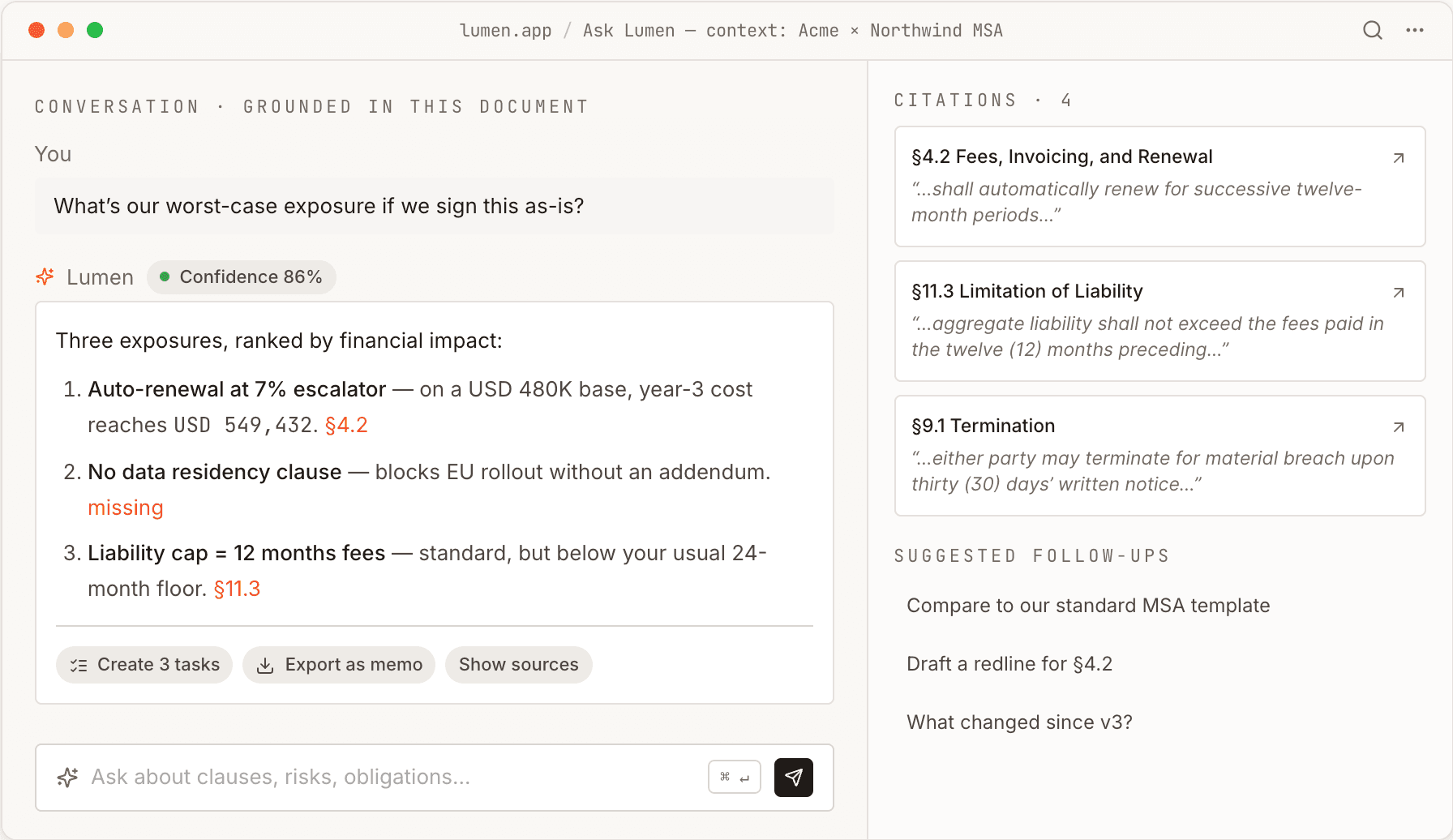
b · AI Copilot
Context-aware, not a chatbot.
Every answer cites the spans it used. Confidence is shown. Suggested follow-ups are grounded in this document, not generic prompts.
c · Structured insights panel
Document as queryable object.
Key fields, risks, and entities — each with confidence and a link back to source. The panel is the bridge between human reading and machine processing.

d · Action layer
Where reading becomes work.
Tasks, extracted data, and workflows derived from the document — all anchored to clauses, all gated on human approval below the confidence threshold.
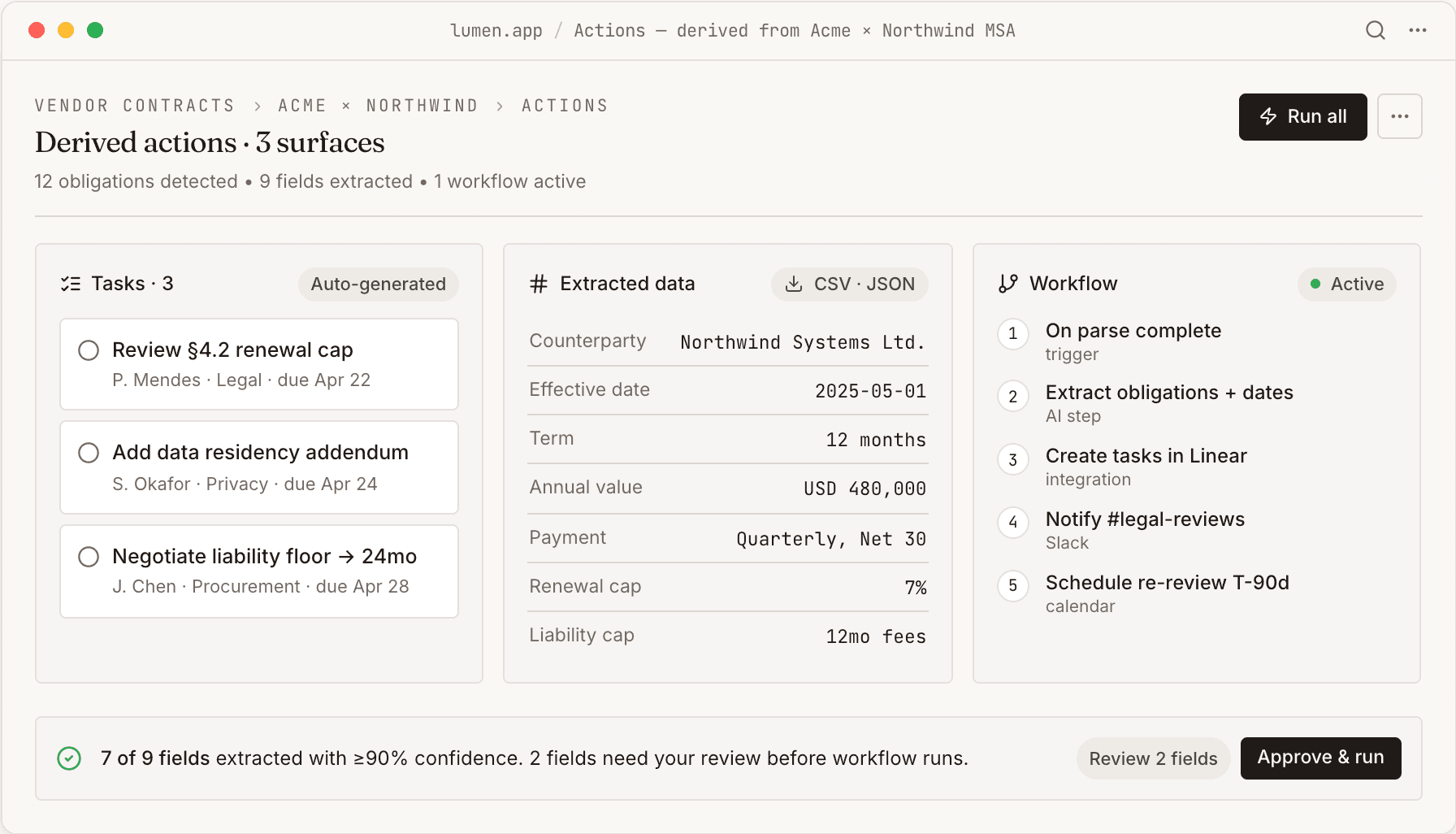
SIGNATURE FEATURE
Turning Documents into Action Systems.
Tasks created from clauses. Structured data extracted from prose. Workflows triggered by document insight.
The intelligence layer continuously interprets document structure and context, enabling actions without requiring explicit user input. The document stops being the end of the work and becomes the start of it.
01
Content → tasks
Select any clause, assign in one keystroke. The task carries the clause as immutable context — even after the document is edited.
02
Content → data
Typed fields extracted across hundreds of similar documents. Schema-aware, with per-field confidence and a human-review queue at the threshold.
03
Content → workflows
Triggers fire on parse events. Compose with Slack, Linear, calendar, CRM. Gated on confidence and field values, not blind automation.
04
Content → memory
Every action feeds back into Understanding. Next document of the same shape, the system proposes the workflow it watched you build.
AI PRINCIPLES
An intelligence layer that interprets, not assists.
The intelligence layer continuously interprets document structure and context, enabling actions without requiring explicit user input.
Contextual interpretation
AI reasons over parsed structure, not raw text. It knows §4.2 is a payment clause inside an MSA — not a paragraph between two others.
Explainability by default
Every insight cites the exact spans it used. No answer ships without a source. No source, no surface.
Confidence as a primitive
Surfaced on every field, every suggestion. Determines whether the system acts, asks, or stays silent.
User override, always
Every AI decision is editable inline. Overrides become training signal for that workspace — never the global model.
Human checkpoints, not full automation
Workflows halt at the confidence threshold. The product's reliability comes from predictable failure, not optimistic success.
Embedded, not adjacent
There is no 'AI tab.' Intelligence runs across the surface and stays silent until it adds verifiable value.
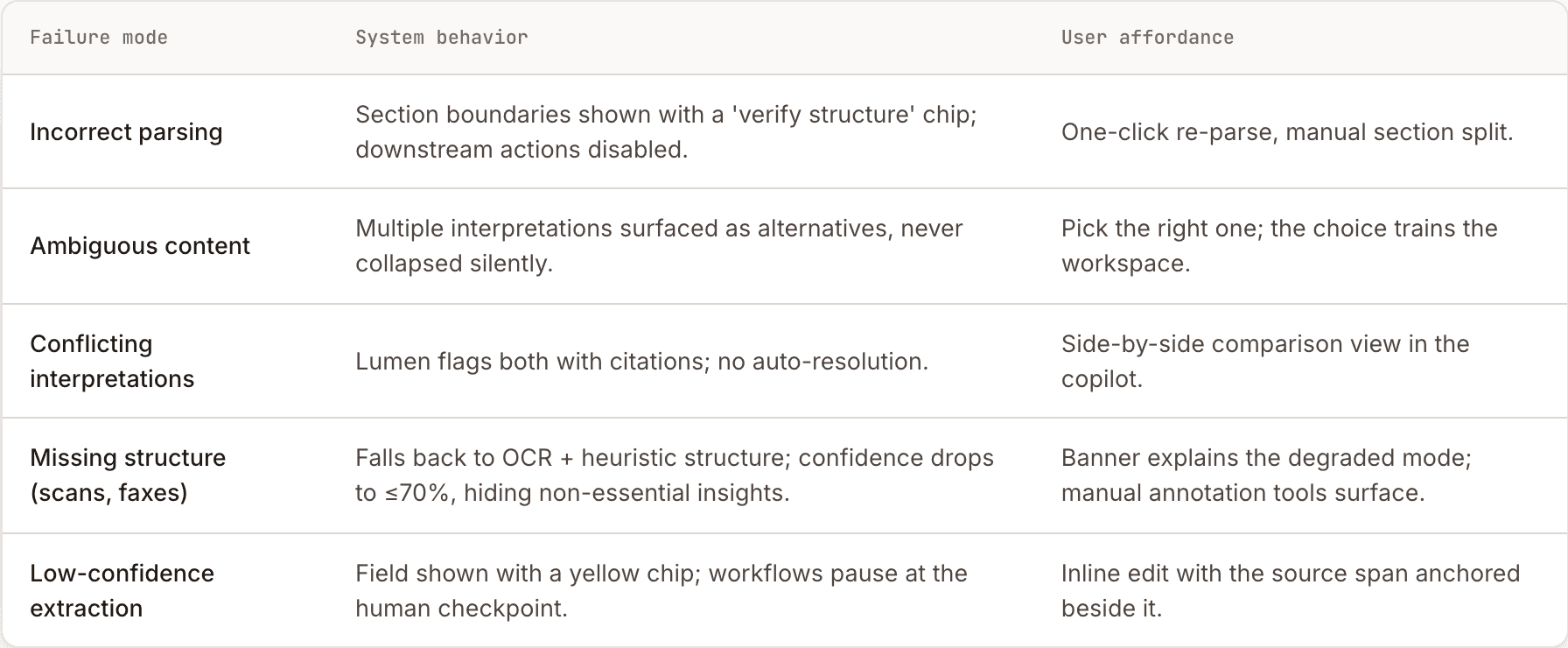
EDGE CASES
What the system does when it’s wrong.
IMPACT
Honest outcomes for an independent project.
No fabricated metrics. As an independent concept project, the honest measure of impact is the clarity of the system and the strength of the decisions behind it.
Manual effort collapses
The copy-paste-into-spreadsheet job goes away. Analysts review, not transcribe.
Understanding compounds
Each document a team processes makes the next one faster. Schemas, flags, and workflows are reusable.
Decisions move earlier
Risk surfaces during reading, not three weeks later in a redline cycle.
Collaboration consolidates
Comments, tasks, and decisions live where the content does. The doc is the source of truth for its own work.
REFLECTION
What I’d do differently, and what I learned.
What I’d improve
Multi-document reasoning. The signature feature is single-doc. The next horizon is portfolio-level: "show me every contract that auto-renews in Q3."
Authoring, not just reading. Lumen consumes documents. The harder, more valuable problem is generating them — drafting clauses that inherit organizational memory.
A real failure-mode study. The edge cases are designed; they aren’t tested with users yet. That’s the gap between concept and product.
What I learned
Confidence is a UI primitive. Once you commit to surfacing it everywhere, half of the AI design problems collapse into a single design system token.
The copilot is the wrong center of gravity. The action layer is. A copilot answers questions; an action layer changes outcomes.
Restraint is the senior move. The hardest decisions in this project were the features I didn’t add. Every feature I rejected made the spine clearer.