Fragmented Enterprise Workflows
Based on my work at a global financial services organisation, focused on internal transaction verification and exception handling.
Reduced unnecessary context switching in high-frequency verification workflows without compromising compliance requirements.
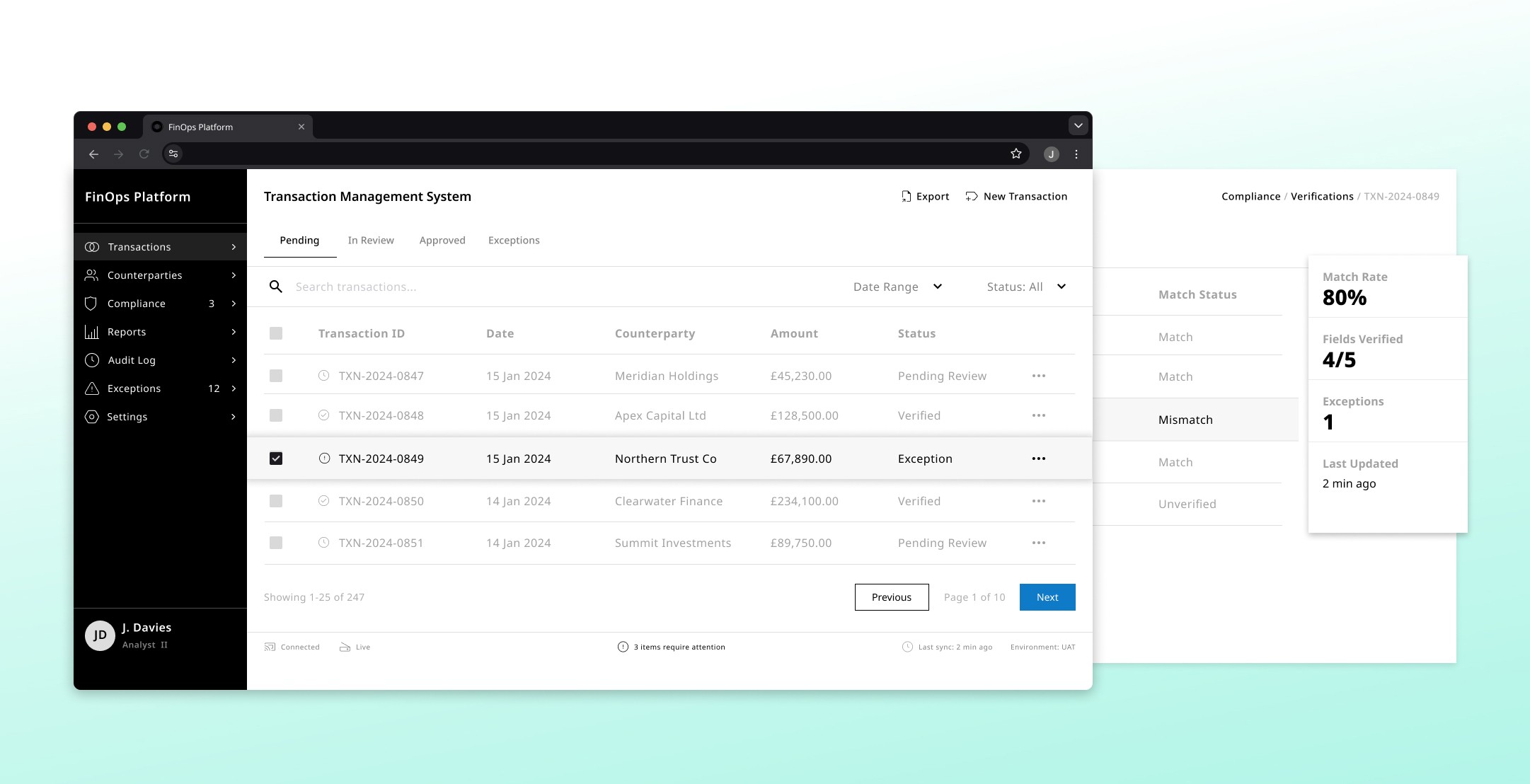
CONTEXT
Enterprise Financial Platform
ROLE
Senior UX Designer
TIMELINE
January - May 2024
TEAM
UX, Engineering, Product, Compliance
PROBLEM
When every second counts, friction compounds fast.
Operations teams review and verify a high volume of financial transactions every day. Each transaction must be checked for accuracy, validated against multiple data sources, and either approved or escalated depending on risk and compliance requirements.
This work is time-sensitive and repetitive. Small inefficiencies compound quickly when the same steps are performed hundreds of times a day.
SOLUTION
We brought decisions closer to the work, not across more screens.
Focused on reducing unnecessary context switching during routine verification by clarifying where decisions should happen and treating exception handling as a normal part of the workflow — all within existing compliance and system constraints.
VALUE DELIVERED
Efficiency improved without trading away compliance or trust.
This work reduced unnecessary effort during high-frequency verification tasks by making decision points clearer and minimizing avoidable system switching. Exception handling became more predictable, allowing operations teams to resolve discrepancies with less back-and-forth and fewer manual checks. Importantly, these improvements were achieved without compromising auditability or compliance requirements.
WHERE THE WORK STARTS
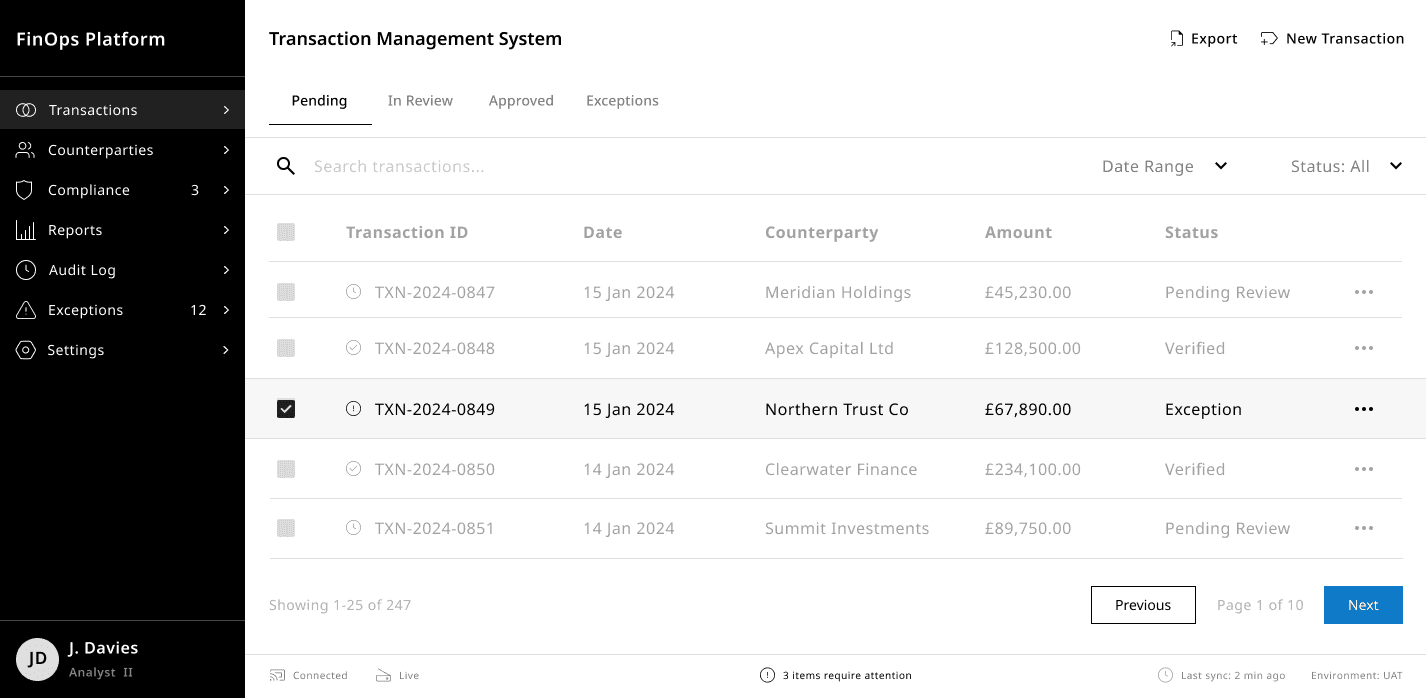
I identified the transaction queue as the single entry point for all verification work.
I started by examining where verification work entered the system. Most tasks began in a central transaction queue that surfaced both routine transactions and potential issues.
At this stage, users could see what required attention, but I found they did not yet have enough information to complete verification.
WHY A SINGLE SYSTEM WAS NOT ENOUGH
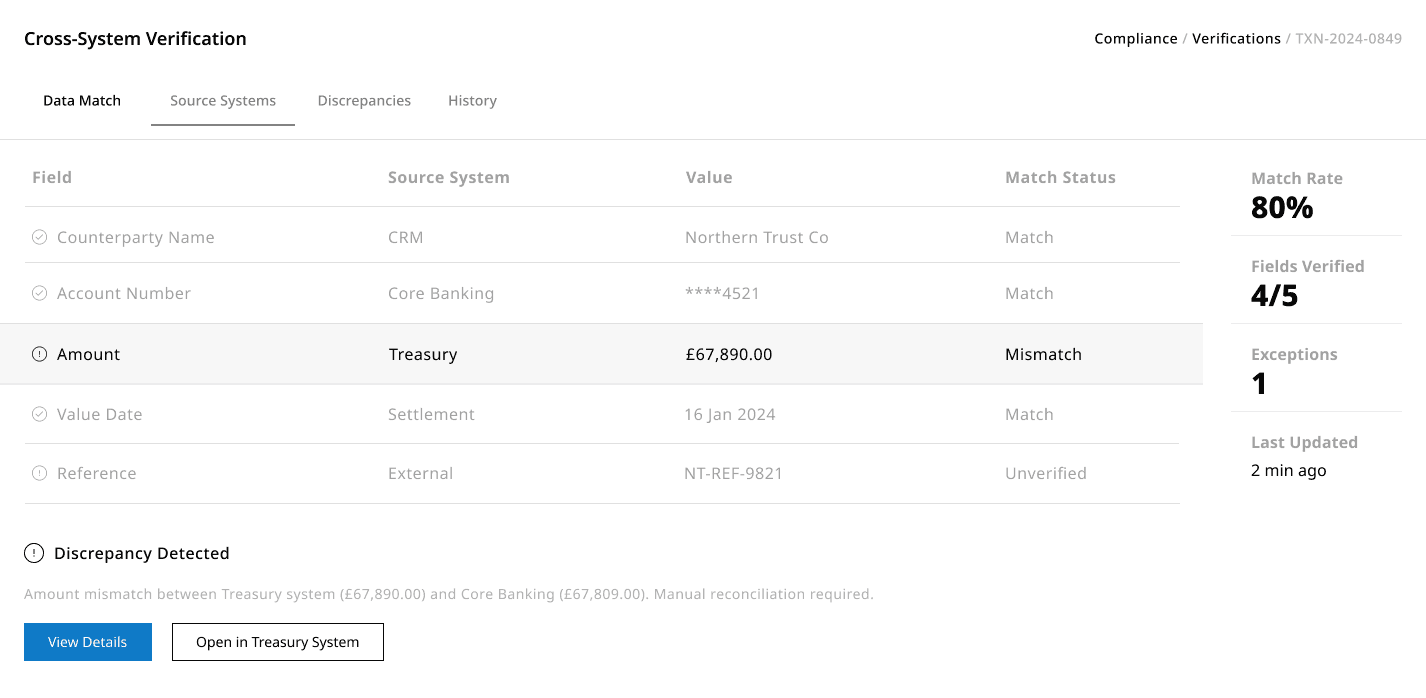
I realised that even simple verification decisions required leaving the primary system.
As I followed verification tasks beyond the queue, it became clear that the system did not contain all the information required to make decisions. To confirm values such as amounts or counterparties, users had to cross-check data across other internal systems.
This forced users to switch contexts frequently and hold partial information in memory while comparing data.
WHEN MISMATCHES OCCUR
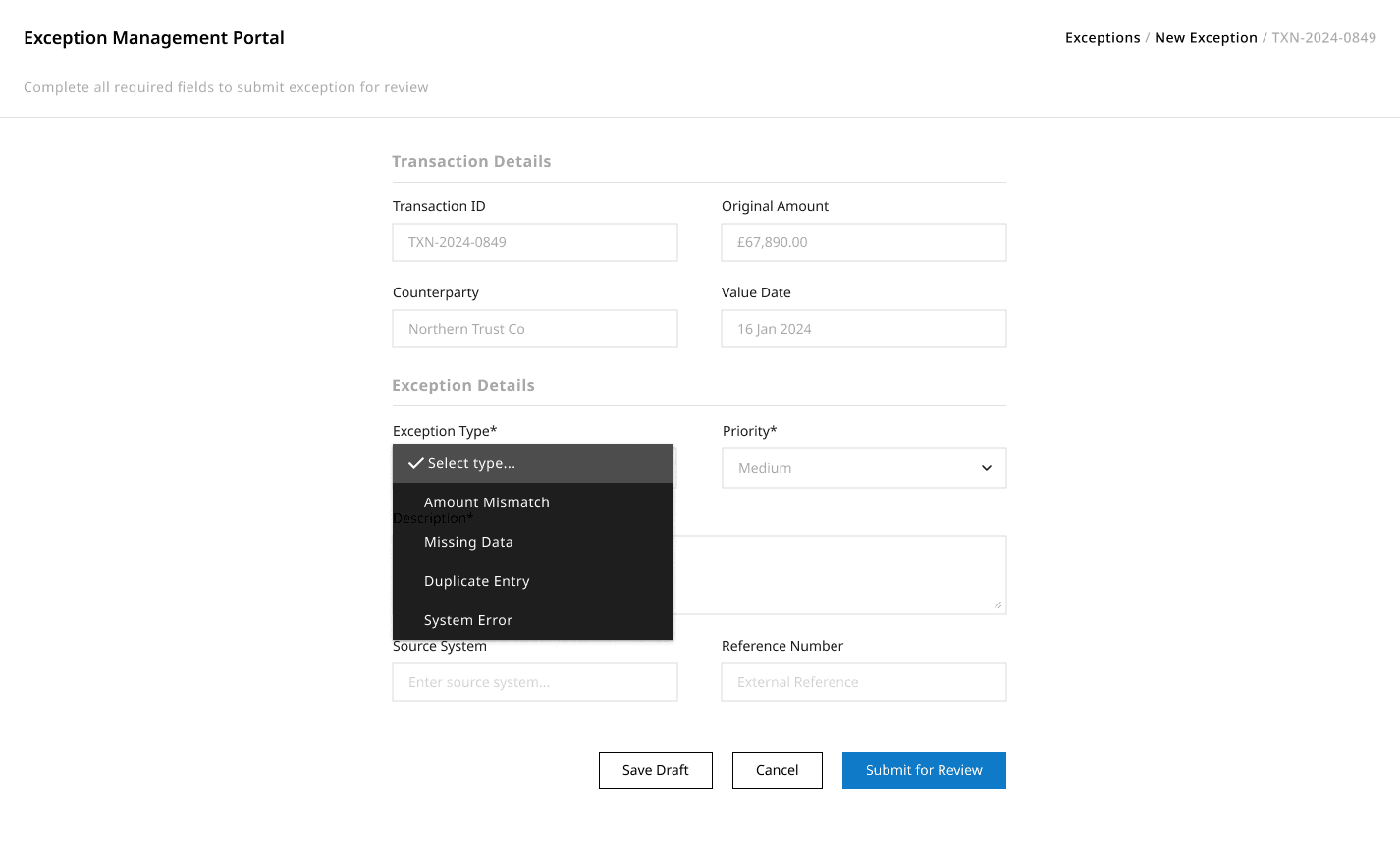
Exceptions were part of normal work, not rare scenarios.
While reviewing multiple cases, I noticed discrepancies between systems occurred regularly. When values did not align, users were pushed into exception handling, requiring manual investigation and documentation before transactions could proceed.
I treated these exceptions as a core part of the workflow rather than edge cases.
WHY THIS BECAME A UX PROBLEM
Systems were shifting cognitive effort onto users.
To complete a single verification, users often had to leave the primary system, maintain context across tools, and repeat checks during exception handling.
I concluded that the issue was not user behaviour or lack of skill. The systems themselves required people to bridge gaps between disconnected tools, making routine work slower and more mentally taxing at scale.
UNDERSTANDING THE WORKFLOW
I traced verification tasks end-to-end to uncover where friction consistently appeared.
Rather than relying on formal interviews, I followed how verification tasks moved across systems in practice. I reviewed multiple transactions from start to resolution and compared repeated exception paths.
This helped me identify consistent patterns of system switching, manual reconciliation, and workarounds. I also discussed these observations with stakeholders familiar with day-to-day operations to validate why these behaviours persisted.
4
Separate systems accessed
6+
Context switches per task
3
Manual data re-entry points
~12 min
Average time per verification
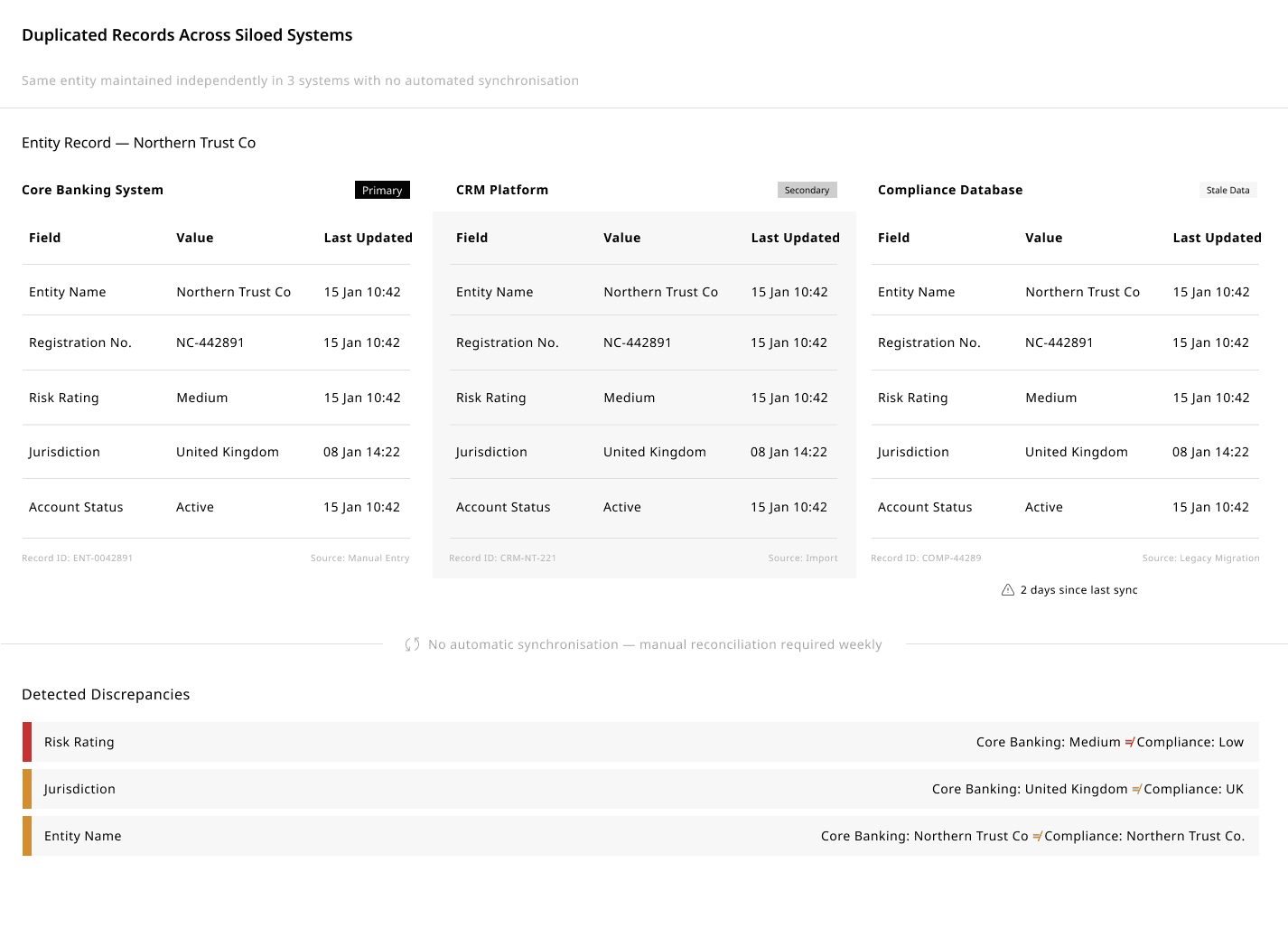
Each system requires separate authentication. No shared context or state persistence between views. Users must manually copy identifiers and cross-reference information across disconnected interfaces.
ROOT CAUSE: FRAGMENTED SYSTEMS
I identified system fragmentation as the primary driver of manual reconciliation.
CONSTRAINTS & REALITY
I worked within audit and compliance constraints rather than designing around them.
Throughout the work, I accounted for strict audit and compliance requirements. Every verification and exception-handling action needed to be fully traceable, including who acted, when, and why.
These constraints shaped what was realistically possible and ruled out approaches such as full system consolidation.
CONSTRAINTS & REALITY
I worked within audit and compliance constraints rather than designing around them.
KEY DECISIONS
I made deliberate trade-offs to keep changes realistic and adoptable.
Early on, I explored consolidating verification data into a single unified view. After reviewing this direction with stakeholders and considering audit requirements, it became clear that this approach conflicted with system ownership and compliance constraints.
Incremental improvements proved more viable.
I focused on reducing unnecessary context switching instead of attempting large-scale system unification
I treated exception handling as a first-class workflow rather than an edge case
I prioritised decision clarity over additional automation where automation was unreliable
I aligned design decisions with system ownership and regulatory boundaries
WHAT DIDN’T WORK
Not every promising idea survived real-world constraints.
Early on, I explored consolidating verification data into a single unified view. After reviewing this direction with stakeholders and considering audit requirements, it became clear that this approach conflicted with system ownership and compliance constraints.
Incremental improvements proved more viable.
OUTCOME & VALUE DELIVERED
My changes made high-frequency verification work more predictable and less mentally taxing.
Reduced unnecessary system switching during routine verification
Made exception handling more predictable and easier to complete
Improved clarity around where verification decisions should occur
Maintained full audit and compliance traceability
REFLECTIONS
This work reinforced the importance of system-level thinking in enterprise UX.
Looking back, I would invest more time earlier in mapping system ownership and constraints to narrow the solution space sooner. This experience reinforced that effective enterprise UX design is as much about judgment and trade-offs as it is about interface design.